
People differ in the way they absorb, process, and store new information and master new skills. Natural and habitual, this way does not change with teaching methods or learning content. This is known as the Learning Style.
By discovering and better understanding learning styles, one can employ techniques to improve the rate and quality of learning. Even if one has never heard the term “learning style” before, they are likely to have some idea of what their learning style is.
For instance, one may learn better through DIY videos instead of reading manuals or pick up things faster by listening to audiobooks instead of sitting down to read. These preferences point to one’s learning style.
How can learning style help in the classroom?
Students can have a single dominant learning style or a combination of styles, which could also vary based on circumstances. While no learning style (or a mix of them) is right or wrong, knowing one’s style can significantly enhance learning.
Research has shown that a mismatch between learning style and teaching can affect students’ learning and behavior quality in class. Studies have found that good learning depends on the teaching materials used, which must align with students’ learning styles.
In recent years, there has been a big push in education on how teachers can better meet students’ needs. Learning style has proven very effective in achieving this. It helps teachers understand how students absorb information and teach effectively.
One study found that over 90% of teachers believed in the learning style idea.
Often, teachers have a lot on their plates, and adjusting instruction to suit different learning styles can sound overwhelming. However, once they master how to appeal to all learners, life in the classroom becomes much easier.
This guide will help you understand various learning styles and how teachers can use them to alter instructions and help students learn more effectively.
This improves classroom management and makes for happier students. The chatty student who constantly interrupts will finally find a positive place in the classroom. The quiet girl who knows all the answers but never raises her hand will feel confident sharing her knowledge.
How can learning style help parents?
As a parent, knowing your child’s learning style helps you find activities and resources tailored to their specific learning styles. This allows you to better connect with them and provide the support they need, which also improves relationships.
Knowing learning styles is also helpful beyond educational settings. It helps you understand how those around you learn—at work, in families, in relationships, or in other settings.
Theory Of Learning Styles
The study of learning styles began in 1910, and formal learning style assessment instruments were developed for academics in the 1970s. By the 1980s, the VAK model, which stands for Visual, Auditory, and Kinesthetic, had gained popularity in the mainstream media.
Thanks to the Internet, VAK became freely available to teachers for assessment by 2000. Later, another dominant style, reading/writing (R), was added to the VAK model, which expanded it to the VARK model.
The VARK model
The VARK learning style model has been adjusted to include four learning modes:
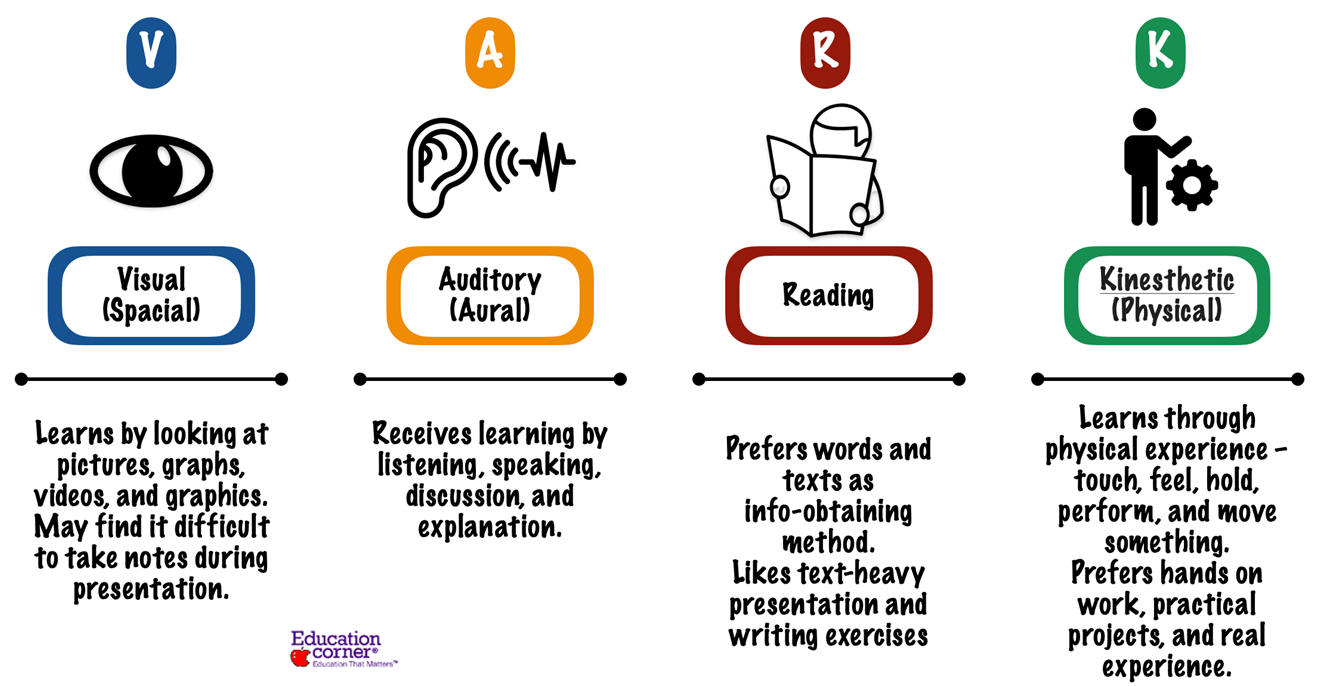
- Visual (spacial) learners learn best by seeing
- Auditory (aural) learners learn best by hearing
- Reading/writing learners learn best by reading and writing
- Kinesthetic (physical) learners learn best by moving and doing
A short questionnaire is used to identify what a learner prefers to use when taking in, processing, and outputting information.
VARK helps explain why it can sometimes be frustrating to sit in a classroom and not get what’s being taught. It also explains why some students learn well from one teacher but struggle to learn from another.
As a student, if you have experienced feelings like this, they are more likely to originate from an incompatibility with your learning style.
According to Neil Fleming and David Baume, who developed VARK, teachers should understand how students learn, but it’s even more important that students themselves know how they learn.
By identifying their own learning process, students can identify and test strategies that significantly improve learning efficiency. According to Fleming and Baume,
“VARK above all is designed to be a starting place for a conversation among teachers and learners about learning. It can also be a catalyst for staff development – thinking about strategies for teaching different groups can lead to more, and appropriate, variety of learning and teaching.”
This kind of thinking is known as metacognition, which refers to an awareness and understanding of one’s thought processes and how to regulate them. Discovering your own learning style without engaging in metacognition would be impossible.
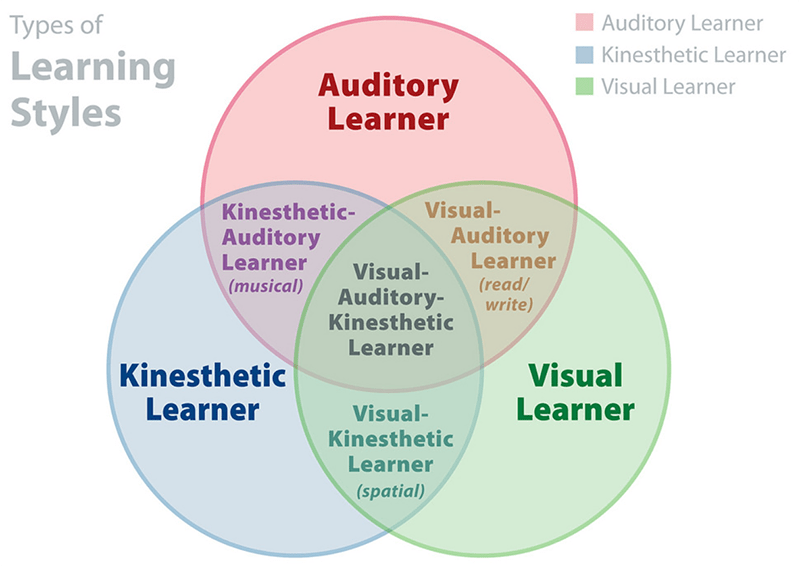
Learning styles can also be multimodal—some have one dominant style, while others combine several learning styles.
Memletics
Various learning theories, in addition to VAK and VARK, have been developed over time. While the labels used in each theory differ, the learning styles they define often overlap.
Memletics is another theory that was created in 2003 by Sean Whiteley. It expands upon the VAK model by introducing seven learning styles:
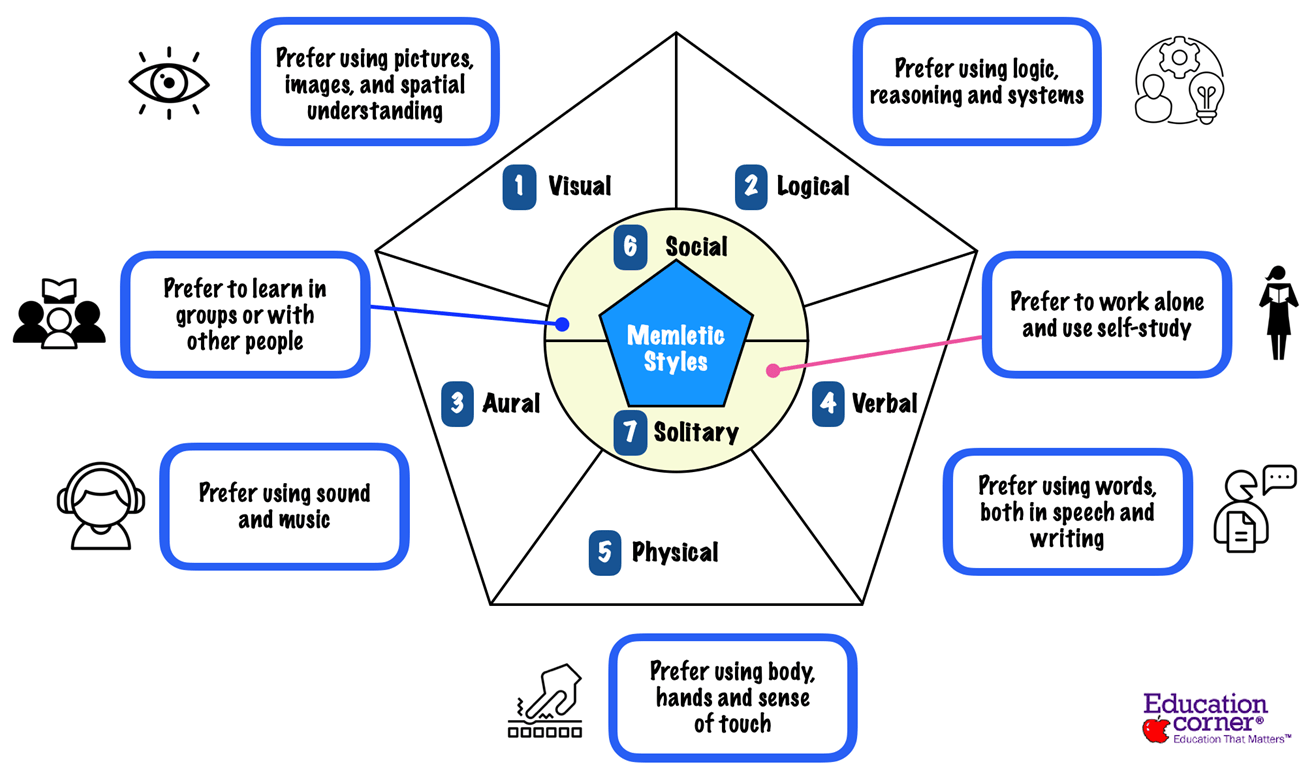
As shown, Memletics adds four more learning styles (Verbal, Logical, Social, and Solitary) to the three learning styles defined in the VAK model. However, it leaves out “Reading/Writing,” added when VAK expanded to VARK.
Due to the nature of these categories, there can be an overlap in learning styles defined in Memletics. Take two solitary learners, for instance. While both learn best in solitary situations, one may learn using logic, while the other may learn by seeing (Visual).
In a study on learning styles, Aranya Srijongjai noted that according to the Memletics model, everyone has a mix of learning styles, and learning styles are not fixed, so instructors should also accommodate other types of learning styles by providing diverse learning environments.
They should vary activities so that students learn in their preferred style and have a chance to develop other styles. Matching and mismatching learning styles and instructional methods will complement the student’s learning performance and create more flexible learners in the long run.
As Srijongjai suggests, students and teachers should not consider learning styles as boxes into which students can be placed. They are just one small piece of the overall puzzle in a student’s learning process.
No matter what learning style theory appeals to you the most, knowing your style helps make learning easier and more successful. Most learners will have at least one dominant style in the VARK theory.
This guide will offer information and advice to teachers, students, and parents to help them understand why and how people learn the way they do.
For each learning style, we have included suggestions for career choices, which in no way are meant to be limiting, but they can be helpful. If you are a visual learner but feel pulled toward one of the fields listed in the auditory learner section, by all means, pursue your passion.
These suggestions merely show what careers a person with a particular style might gravitate toward and where they are likely to excel with minimal effort.
Understanding your learning style is helpful, but again, you should also be careful not to put yourself in a box and define yourself by your learning style. The key is understanding how you learn and avoiding getting caught up in labels and classifications.
Take what insight you can, but don’t let it overcome your thoughts about yourself, as you may very well lie at the intersection of the “standard” learning styles:
Visual Learners
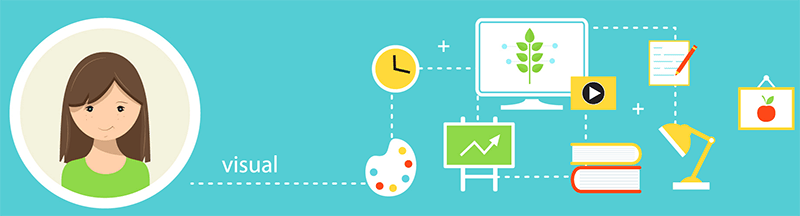
Do you ever remember taking a test in school and thinking, “I don’t remember the answer, but I remember I had it highlighted pink in my notes”? If the answer is yes, then you might be a visual learner.
Visual learners remember and learn best from what they see. This doesn’t necessarily have to be restricted to pictures and videos. They do well with spatial reasoning, charts, graphs, etc. Visual learners often “see” words as pictures or objects in their heads.
Visual learners use their right brain to process information. The human brain processes visual information much faster than plain text. Some reports claim that images are processed 60,000 times faster than text.
As a visual learner, you can quickly take in and retain a lot of information because you prefer this processing method that humans are already very good at.
Visual learners prefer using maps, outlines, diagrams, charts, graphs, designs, and patterns when studying and learning. They are more likely to organize their notes into visual patterns or separate their pages of notes into different sections. Many visual learners also do well by color-coding their notes.
Careers For Visual Learners
Visual learners are often drawn to and do well in STEM fields (Science, Technology, Engineering, and Math). Career options include Data Analytics & Visualization, Graphics Design, Photography, Architecture, Construction, Copy Editing, Interior Design, Physics, Advertising, Engineering, and Surgery.
A Note On Visual Learners For Teachers
Sometimes, students who are visual learners might stare out the window or doodle in their notes. If this is the case, let them do it. Locking their eyes constantly on you can be too visually stimulating for these students.
Sometimes, it’s the flower that they draw next to their notes that helps them remember the point by bringing out a visual connection.
It’s also easy for visual learners to get overwhelmed by a lot of visual input. If the classroom setting is chaotic, with many students moving around, it might be too much for these students to take in.
The design of a classroom is very important to visual learners. Clutter or too many posters adorning the walls can easily overwhelm their minds and processing.
Some visual learners may find it helpful to pay careful attention to your movements. They might even remember the silly hand motion you made or how you pointed to a country on the map. Keeping this in mind when delivering your lessons can be very effective.
Lesson Ideas To Help Visual Learners
Draw text and words
Make it a habit to write new words and add a few quick context clues (e.g., putting the part of speech in brackets or underling the stressed syllable). Pick out a portion of the text with especially vivid imagery and instruct students to draw a picture of what the writing describes. This will help visual learners read and understand the text better.
Use Colors
Visual learners tend to color code things naturally. It can be helpful if you, as a teacher, also color code your notes as you write or post them. You could, for example, designate roles for certain areas of the board and use colors to organize information during the lesson.
Or, for homework or in-class assignments, you could have students annotate/read actively and use different colors for different things you want them to look for. For example, they could highlight dates in blue and names in yellow.
Use charts and graphs
Create charts and graphs to help students visualize information. While math and science subjects typically provide the ideal setting, they can be used in other disciplines as well.
For instance, in a social science class, students could track local election participation rates over ten years and create line graphs to visualize trends. This will give them a deeper understanding of civic involvement dynamics in their community.
Such assignments engage visual learners and allow them to recall information more easily, organize concepts, and articulate their thoughts more easily. Try:
- Venn Diagrams (that represent comparisons and contrasts)
- Timelines (to visually represent a series of events)
- Inverted Triangles (that go from broad topics to more specific ones).
- Story or Essay Planners (that guide students through the steps necessary to complete tasks)
- Charts to list word families – add columns for verbs, adjectives, adverbs, and nouns and fill them as words come up. (e.g., engage, engaging, engagingly, engagement)
Use posters and flashcards
As a project or class assignment, ask students to make posters illustrating key concepts. Students can even present their posters to the class – which would benefit auditory learners. Display these posters on the wall to help drive home important topics.
Flashcards also provide visual cues to young learners and can be used to teach various concepts. To build vocabulary, for example, the word “yummy” may be drawn as swirls of an ice cream cone that helps visual learners remember.
A number of classic games can also be designed using flashcards that help visual learners interact visually and learn better.
Draw reasoning
In math, teach students to draw out their reasoning. For example, instead of verbally explaining how to add 3 and 5, you could create a sketch that depicts two baskets with 3 and 5 apples each. Counting all the apples in your drawing visually demonstrates that 3 plus 5 equals 8, making it easier to understand.
Use gestures
Be aware of your body language when you teach. Including gestures and hand motions when you speak will help visual learners pay attention and make connections.
Auditory Learners

Do you sometimes talk to yourself when thinking hard, studying, or trying to organize something? If that sounds like you, you’re likely an auditory learner.
Auditory learners learn best by carefully hearing and listening. This can include listening to external sources and hearing themselves talk. They will likely volunteer to answer questions and actively participate in classroom discussions.
Auditory learners have a great advantage in the classroom because they are not afraid to speak their minds and easily get answers to their questions. Consequently, they process information very easily, right there in the classroom.
In contrast, reading/writing learners might not even realize they have a question until they’ve had time to go back and process their notes.
For auditory learners, any form of listening or speaking is the most efficient learning method. This can include lectures, audiobooks, discussions, and verbal processing. They are also typically good at storytelling and public speaking.
Many auditory learners prefer studying and working in groups because they prefer to talk through the information, which makes them “social learners,” as per Memletics.
Careers For Auditory Learners
Any job that requires a lot of listening and/or speaking will likely be an excellent fit for an auditory learner. Some career fields to consider include law, psychiatry or therapy, guidance counseling, customer service, sales, speech pathology, journalism, and teaching.
A Note On Auditory Learners For Teachers
Just like visual learners, even auditory learners might stare into space, but for a different reason. Since they process information best by listening, they don’t need to look at notes or PowerPoint very often. While this may seem like they are zoning out or not paying attention, it’s generally not the case.
If you’ve ever caught a student staring off into space and asked them a question, thinking you’ve caught them off guard, only to get the perfect answer, you’ve likely found a very auditory learner.
These students also tend to get chatty during class. This can be great when trying to get a lively class discussion or debate going but not when you need the class to listen intently.
Before this frustrates and angers you, remember that this is how their brain works and learns. As much as you can and as much as is practical based on the subject, try to facilitate discussions and play into this rather than squashing it.
Remember that auditory learners may really struggle with written and visual information.
These are the students who can answer every single question you ask in class and then score just 60% on an exam that tests the same information. If you suspect that a student who bombed a test actually knows much more, give them a chance to answer those questions verbally.
Lesson Ideas To Help Auditory Learners
Audiobook
For obvious reasons, audiobooks are perfect for auditory learners. Give these students the option to listen from an audiobook—this can be effective with both novels and textbooks.
Socratic Seminar
A Socratic seminar is a student-led discussion based on a text in which the teacher asks open-ended questions to begin with. Students listen closely to each other’s comments, think critically for themselves, and articulate their thoughts and responses to others’ thoughts.
They learn to work cooperatively and to question intelligently and civilly. Discussions usually occur in a circle, and the atmosphere is laid-back, encouraging every student to join the conversation.
Auditory learners often lead such discussions. It gives them a chance to shine and be rewarded for talking, which usually gets them in trouble otherwise.
Teacher Kelly Gallagher offers a great handout called Trace the Conversation that can help auditory and visual learners with Socratic seminars. There are many ways to conduct Socratic Seminars; the National Council of Teachers of English has a great explanation.
Speeches
Speeches, the often hated but necessary school assignment many students dread, are a favorite of auditory learners. When it comes to speeches, auditory learners feel in their element. Speeches can be short and impromptu or long and planned, and they can be on any subject.
Recorded notes
You can either record yourself speaking or permit your students to record lectures so they can listen later. You can also encourage students to record themselves reading their notes.
Text to speech
Students can do this independently, but they might need your prompting or feel better about doing it if you permit them. Document processors like Microsoft Word and Google Docs have text-to-speech and speech-to-text embedded as standard.
Students can, for instance, use speech-to-text to capture their thoughts when writing essays. Text-to-speech can also be beneficial for proofreading and catching errors.
Debate
A structured debate is beneficial for auditory learners to get their ideas across. It can be done at all grade levels and in all disciplines. Here is a great resource for some debate ideas and different debate formats for different grade levels.
Reading/Writing Learners
Do you tend to zone out when people talk to you or when you hear a lecture? Would you instead read the transcript or get the information from a book? Then, you’re probably a reading/writing learner. You learn best by reading and writing.
Reading/writing learners often relate to the famous Flannery O’Connor’s quote: “I write because I don’t know what I think until I read what I say.”
For these learners, verbal input can often go into one ear and out from the other without much effect. Seeing notes on the board or a PowerPoint presentation is very important to them, as is taking notes.
These students learn best from books, lists, notes, journals, dictionaries, etc. They can also intuitively help themselves learn by rewriting notes, using flashcards, adding notes to pictures or diagrams, choosing a physical book over an audiobook, and using closed video captions.
Careers For Reading/Writing Learners
Writing is a common and obvious career choice for reading/writing learners, but if this is your learning style, you’re definitely not limited to writing. Editing, journalism, public relations, law, teaching and education, marketing, advertising, researching, translating, and economic advising are all excellent career choices.
A Note On Reading/Writing Learners For Teachers
Reading/writing learners are often your typical “good students.” However, they can really struggle to learn from lectures or completely auditory methods. They may not respond well to class discussions and need more time to process what they hear.
Help them by giving them time to write down their thoughts before asking them to share out loud. This will reduce their stress and allow them to process their thoughts.
As a teacher, you will likely encounter students who need more time to understand a concept, even after you have finished explaining it. These students are most likely reading/writing learners.
Knowing their learning style makes it easier to be more patient and provide them with the necessary support. They sometimes struggle to take notes because they try to write down everything you say. Help them by working with them to pull out the most important parts of your lecture and paraphrase what they hear.
Lesson Ideas To Help Reading/Writing Learners
Handouts
No matter what the lesson is about, providing handouts highlighting the most important information is one of the best things you can do to help reading/writing learners. It’s also important to give them enough time to write detailed notes.
Essays and reading assignments
These simple assignments work best for reading/writing learners. This is why they often thrive in the traditional classroom setting.
Vocabulary stories
Have students create stories or plays to make their vocabulary words more fun and exciting. This can be done in any subject area that has vocabulary words.
You can give students a topic or let them be creative, but all they have to do is write a story containing x number of vocabulary words. You can also extend this activity to help kinesthetic learners by having students act out their stories for the class.
Think, pair, share
Reading/writing learners often struggle with sharing their thoughts out loud. They ace their tests but freeze when you call on them in the class. Think-pair-share can help give them the confidence they need to verbalize their thoughts and is suitable for most age groups in almost any subject area.
First, ask students an open-ended question and give them time to think silently and write their answers. Then, have students pair up in small groups to share their answers. Then, open the discussion to the whole class.
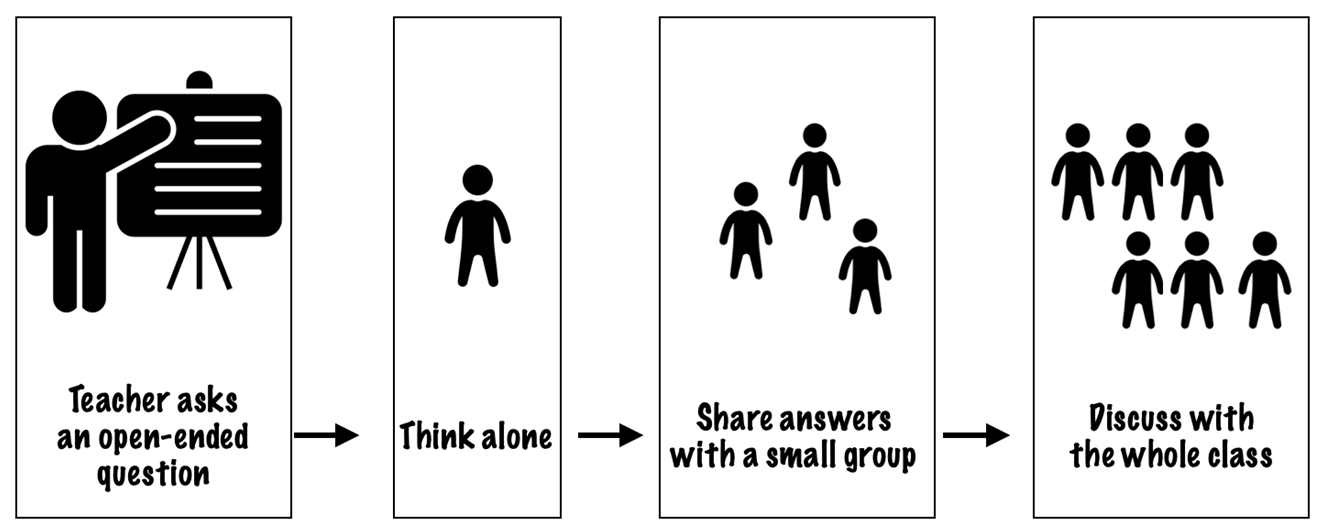
When you ask a question and want students to respond right away, you’ll likely get answers only from the auditory learners—they are the quickest at verbal processing.
With think-pair-share, the reading/writing learners get the time they need to process. In that time, they develop the confidence to construct a verbal response and are very likely to respond.
Kinesthetic Learners

Are you the first to stand up and volunteer to demonstrate an experiment for everyone else? Do you need to change the oil rather than look at a diagram to learn how to do it? If the answer is yes, then you are most likely a kinesthetic learner.
The root word “kines” means motion and a kinesthetic learner learns best by “going through the motion” or doing the task. It’s much easier for them to internalize the information when they are actively moving their body and combining that with what they are learning.
These students tend to shine in demonstrations and experiments. They also learn best from seeing something firsthand, like watching live videos and going on field trips.
Combining a physical motion, such as fidgeting, with a piece of information can help them learn better. They are likelier to use active gesturing and “talk with their hands.”
Careers For Kinesthetic Learners
Any career that allows physical activity and requires movement is right up the alley of a kinesthetic learner. These are the ones who often use the phrase “I don’t sit well.”
Kinesthetic learners typically don’t thrive well at desk jobs. Good career options for such learners include physical or occupational therapy, nursing, dance, theatre, music, automotive technology, welding, on-site engineering jobs, carpentry, agriculture, environmental science, forestry, and marine biology.
A Note On Kinesthetic Learners For Teachers
Just because you see a student fidgeting or being antsy, it doesn’t mean they aren’t paying attention or are bored. Their brain craves that movement to help them make connections.
There’s no need to force such students to sit entirely still as long as they aren’t distracting others in the classroom. Try to connect movement to the concepts you’re teaching as much as possible. Kinesthetic learners need to move, and they can benefit from active brain breaks.
Do your best to keep them active and allow movement in your classroom. If you notice a student with a glazed-over look, take a 30-second break from the lesson and have the entire class stand up, stretch, or do some jumping jacks.
Or you could ask your kinesthetic learner to run a quick errand to the office.
As students, kinesthetic learners often get punished for trying to move and follow their natural learning style. The more you can find ways to reward them for their learning style, the more engaged they will become.
Lesson Ideas To Help Kinesthetic Learners
Labs and experiments
While labs and experiments are standard in science classes, they can also be successfully implemented in the curriculum of other subjects to benefit kinesthetic learners.
For example, an elementary math lesson could involve measuring each student’s height and creating problems based on the measurements. Geometry, for instance, could be taught using hands-on activities and tangible objects, like clay or building blocks, for better comprehension.
Field trips
With tightening school budgets, it can be hard to plan educational field trips, and that’s understandable. However, field trips need not have to be major events.
An art project, for example, could involve taking students outside and having them draw or photograph what they see. An English lesson could include a nature walk during which students journal or write a story about their little field trip.
Physical props
Use practical and/or memorable props; for example, when teaching a history lesson, dressing in the attire of the era you are teaching about will greatly impact kinesthetic learners. If you’re an anatomy teacher, consider using a model skeleton or demonstrating with your body as a helpful visual aid.
Take a stand
This activity is easy to set up and appeals to both kinesthetic and auditory learners. It requires you to prepare a series of questions that students can agree or disagree with.
For instance, if your students read “To Kill A Mockingbird,” your questions could revolve around racism. (Note: when tackling a sensitive subject such as racism, make sure you know your students and their maturity level)
Have signs on either side of your classroom indicating “agree” and “disagree.” Read through each question and have students move to the side of the room that fits their beliefs. Once there, they can discuss their thoughts with the group that follows their beliefs, and then you can open the discussion to the whole class.
Act it out
This works well for literature and history lessons. Instead of reading silently, assign students parts and have them act out the story.
Tableaux Vivants
Tableaux Vivants is a time-tested process drama technique that can enhance students’ engagement and comprehension of abstract learning material across the curriculum. It works well in literature and history classrooms and is a great review activity. It is very similar to charades.
It involves breaking students into groups and assigning each group a “scene” – this could be from a work of literature or a scene from history. Each group then works together to create a silent re-enactment consisting of “snapshots” of the scene.
Students pose and pause for 5-10 seconds before moving on to their next pose. Once they have moved through all their poses, the rest of the class guesses what scene they were re-enacting.
Demonstration speeches
Einstein once said: “If you can’t explain it simply, you don’t understand it well enough.” Demonstration speeches allow students to explain something they understand well to their peers.
Ask your students to pick a topic, such as how to make a peanut butter and jelly sandwich. Ask them to give a speech explaining the process while simultaneously demonstrating it.
The demonstration part appeals most to kinesthetic learners. Since students can choose their topic, it also appeals to all other learners, creating an engaging learning experience.
Logical Learners
If a child is good with numbers and asks many questions, they might be a logical learner. A logical learner has a core need to understand what is being learned. For them, simply memorizing facts is not enough. They thrive on orderly and sequential processes.
Individuals who excel at math and possess strong logical reasoning skills are usually logical learners. They notice patterns quickly and have a keen ability to link information that would seem unrelated to others. Logical learners retain details better by drawing connections after organizing an assortment of information.
As a logical learner, you can maximize your ability to learn by seeking to understand the meaning and reasoning behind the subject you’re studying. Avoid rote memorization.
Explore the links between related subject matter and ensure you understand the details. Use ‘systems thinking’ to better understand the relationship between various parts of a system. This will not only help you understand the bigger picture but also help you understand why each component is important.
Social Learners
Social learners have excellent written and verbal communication skills. They are at ease speaking to others and adept at comprehending other people’s perspectives. For this reason, people frequently seek counsel from them.
Social learners learn best when working with groups and take opportunities to meet individually with teachers.
If you like bouncing ideas off others, prefer working through issues as a group, and thoroughly enjoy working with others, you may be a social learner. Seek opportunities to study with others. If your class doesn’t have formal groups, form one.
Solitary Learners
Solitary learners prefer working by themselves in private settings. They avoid relying on others for help when solving problems or studying and frequently analyze their learning preferences and methods.
Solitary learners tend to waste a lot of time on a complex problem before seeking assistance. If you are a solitary learner, you must consciously recognize this limitation and try to seek help more often/sooner when stuck.
Generally, solitary learning can be a very effective learning style for students.
Tips to Simultaneously Help Learners of All Types
Lessons tailored to suit multiple learning styles are often the most effective, as they reach and appeal to most students. Another reason they are best suited is because most people have a combination of learning styles.
The activities discussed in this article provide ample opportunities for all types of learners to benefit. As a teacher, if you try to be creative, you can make little tweaks in almost every lesson to reach different learning styles.
Following are some ideas and ways by which to reach all four VARK learning styles:
Centers
Split your space into multiple stations (or centers) spread throughout the classroom. Break your students into groups so there is a group at every station.
Then, assign activities for each station that focus on a learning style. Have the students rotate with their groups from one station to another.
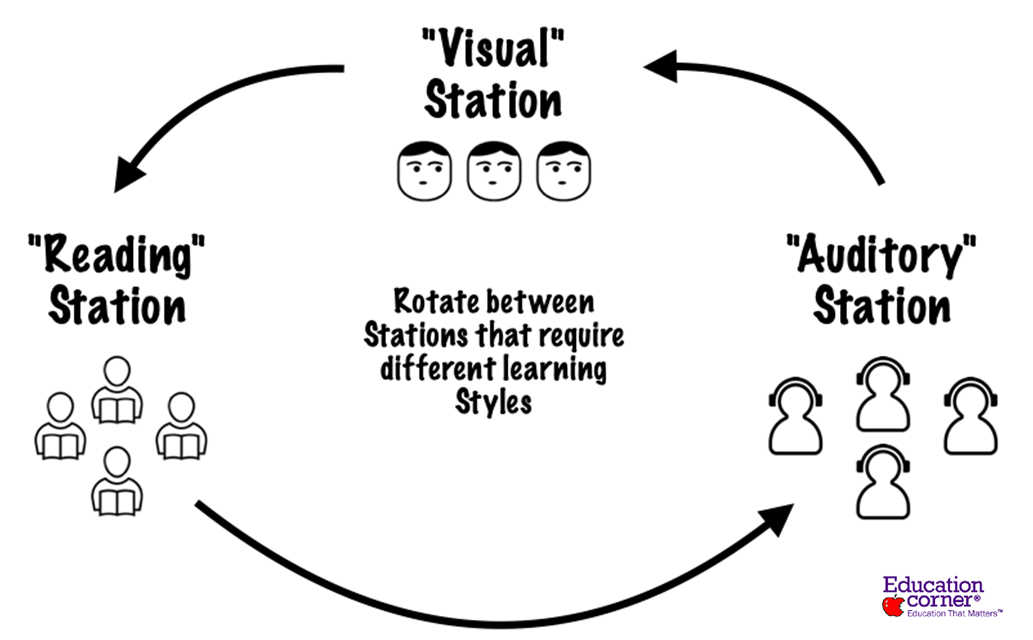
While the obvious benefit of rotation is that it ensures the activities cover each type of learner’s needs, there is more to it.
Even if you don’t have a center that caters to kinesthetic learners, the simple act of getting up and moving around different stations in the classroom helps them. The same goes for auditory learners; being in small groups and rotating throughout the room encourages discussion.
Give options
Irrespective of what subjects you teach your students, give them options as far as possible. For instance, instead of assigning an essay at the end of a unit, assign a project that can be completed with multiple activities.
Don’t mention which choices align with which learning style—let the students decide. Here is an example of 4 different options for a homework project:
- Write an essay (appeals to reading/writing learners)
- Record a podcast or TED talk (appeals to auditory learners)
- Film a video (appeals to kinesthetic learners)
- Create a poster or multimedia project (appeals to visual learners)
Quite often, students will naturally gravitate toward the option that best suits their learning style.
Headphones
Allow students to use headphones when working independently in class. This helps cut out distractions for most learning types. Particularly for auditory learners, it can help make connections between what they hear and what they’re learning, which can be very helpful for them when they need to work silently.
Technology
Technology has made great strides and deep inroads into education. Several apps and websites can help students in various ways. Here is a list of apps for elementary math that could appeal to all four learning styles.
Games that include pictures and sound can help visual and auditory learners. Reading explanations and lessons on apps helps reading/writing learners. Physically manipulating and touching a device helps kinesthetic learners.
A quick online search will reveal several beneficial websites and apps for almost any discipline.
Final Words
There is no right or wrong when it comes to learning styles; they are simply names and categories assigned to how people’s brains process information.
It is generally easier for those with a dominant reading/writing style to succeed in a traditional academic setting, thus securing the “good student” label. However, education has come a long way, and schools and teachers can cater to various styles.
As a teacher, it’s important to remember that every student is unique. Even two visual learners might differ significantly in terms of what works for them. The best approach is to learn about and understand each student’s unique educational requirements.
After all, students are human beings with unique needs and feelings; teachers who remember this can approach them empathetically.
If you are a student interested in knowing about your learning style, you can begin by taking the VARK questionnaire. Having your students take the questionnaire is a good idea if you’re a teacher. Not only will you discover your student’s learning styles, but they will also be able to identify which techniques work best for them.
Remember, learning style is only a partial explanation of a student’s preferred way of learning. It is never the complete picture. These styles change over time, and every student can have differing degrees of inclination toward a given style.
However, regardless of your position in education, recognizing both your own learning styles and those of others around you can be highly beneficial.